


World's largest bulk-to-container conversion completed in China
China Classification Society (CCS) has completed inspection and certification work for what is believed to be the world’s largest bulk carrier-to-container ship conversion project, marking a significant milestone for the ship conversion sector.
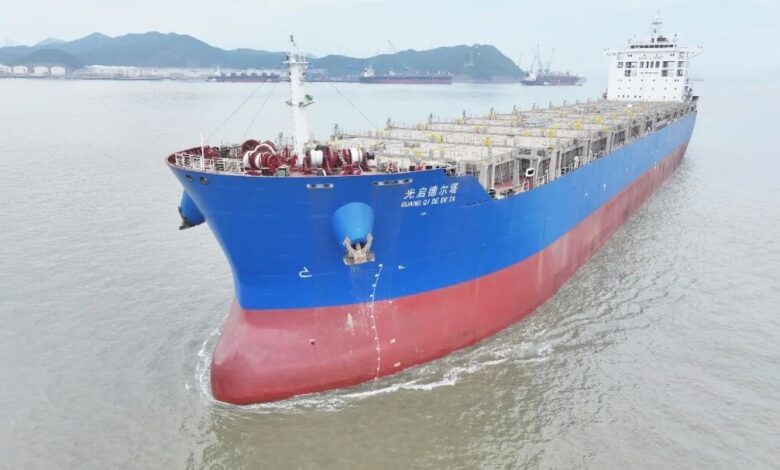
The 80,000-dwt Kuang Chi Delta (pictured) was officially delivered following an extensive six-month conversion programme at Zhoushan Xinya Shipbuilding & Repair. The project transformed the vessel from a bulk carrier into a 3,600 teu containership, making it the first conversion of its kind at this scale and currently the largest bulk-to-container conversion undertaken globally.
The refit involved major structural modifications to the hull, a complete redesign of the cargo hold arrangement, installation of a new container lashing system, and upgrades to supporting onboard systems. Given the scale and complexity of the work, the project was considered one of the most technically demanding ship conversion programmes completed in recent years.
The sustained strength of the container market is prompting shipowners to reach beyond the orderbook for solutions, with plans now underway to convert at least another two supramax bulk carriers into cellular container vessels of around 2,500 teu, according to Alphaliner.
The vessels earmarked for conversion are Diamond 53 type open-hatch supramaxes, primarily built between 2005 and 2011 by CSSC Chengxi Shipyard at Jiangyin, China. Their double-hulled, open-hatch design makes them among the more practical candidates for conversion, Alphaliner said last month, requiring relatively straightforward modifications compared with conventional bulk carriers.
The main changes involve removing the ships’ four centreline cranes and raising the wheelhouse by approximately two decks to allow container stacks of seven tiers on deck. Vessel dimensions remain unchanged at 190 m in length and 32.29 m in breadth, accommodating 13 rows of containers.
The conversions are the latest sign of a container market still operating with limited slack. With most vessels sold out and charter rates remaining elevated, the incentive to bring non-standard capacity to market is rising.
The blurring of lines between bulk and container shipping is not a new phenomenon. It is reported in January that COSCO Shipping Bulk had ordered a series of container-capable newcastlemax bulk carriers – three 210,000 dwt vessels from CSSC Qingdao Beihai Shipbuilding, featuring methanol- and ammonia-ready designs with the ability to carry containers alongside bulk and general cargo.
The flexibility strategy has clear precedent from the pandemic era, when boxes migrated onto bulkers and Star Bulk became one of the first cape owners to secure class approval for container carriage.


